

Running a growing business means making hundreds of decisions every day. Some decisions are obvious, like responding to customers or managing sales. Others happen behind the scenes but have a major impact on profitability.
One of those areas is inventory.
A business may have products available, but does it know exactly how much stock it holds? Does it know which items are selling quickly, which products are sitting too long, and when it should reorder?
Many businesses struggle with these questions because inventory records are spread across spreadsheets, sales systems, paper records, or different tools that do not communicate with each other.
This creates uncertainty.
A product may appear available in records but be missing from the shelf. A business may order more stock while existing products remain unsold. A customer may want to purchase an item that is no longer available.
These challenges are why inventory management for small businesses is not just about counting products. It is about creating visibility, improving decisions, and maintaining control over one of the most important parts of a business.
Key Takeaways
- Inventory management helps businesses understand what stock they have, where it is located, and when action is required.
- Poor inventory visibility can lead to missed sales, unnecessary spending, and cash being tied up in slow-moving products.
- Effective inventory control combines accurate records, regular monitoring, and better purchasing decisions.
- Inventory management systems help growing businesses reduce manual errors and improve operational visibility.
- Better stock management creates stronger foundations for business growth.
What Is Inventory Management?
Inventory management is the process of tracking, organising, and controlling the products a business purchases, stores, and sells.
For a retailer, inventory may include finished products available for customers. For a manufacturer, it may include raw materials, components, and finished goods. For service-based businesses that hold equipment or supplies, inventory management can also help monitor important resources.
The purpose is simple: businesses need to know what they have, what is moving, and what requires attention.
A strong inventory process gives businesses visibility into stock levels, product movement, purchasing decisions, and customer demand.
Without accurate inventory information, businesses often rely on assumptions. They may reorder too early, reorder too late, or fail to identify problems until they affect customers.
Why Inventory Management Matters for Small Businesses
Inventory represents money that a business has already invested.
When a company purchases stock, cash leaves the business. That money only returns when those products are sold. This means inventory decisions directly affect cash flow, profitability, and day-to-day operations.
Poor inventory management can create two opposite problems.
The first is having too little stock. When popular products are unavailable, businesses risk losing sales and disappointing customers.
The second is holding too much stock. Excess inventory can tie up cash, increase storage costs, and leave businesses with products that are difficult to sell.
Effective inventory management helps businesses maintain balance. It provides the information needed to understand customer demand, make smarter purchases, and avoid unnecessary costs.
According to guidance from Business.gov.uk, businesses need effective inventory processes to manage stock levels, improve efficiency, and support better operational decisions as they grow. Government business guidance also recommends maintaining accurate inventory records and regularly reviewing stock levels to reduce costly errors and support better business decisions.
How the Inventory Management Process Works
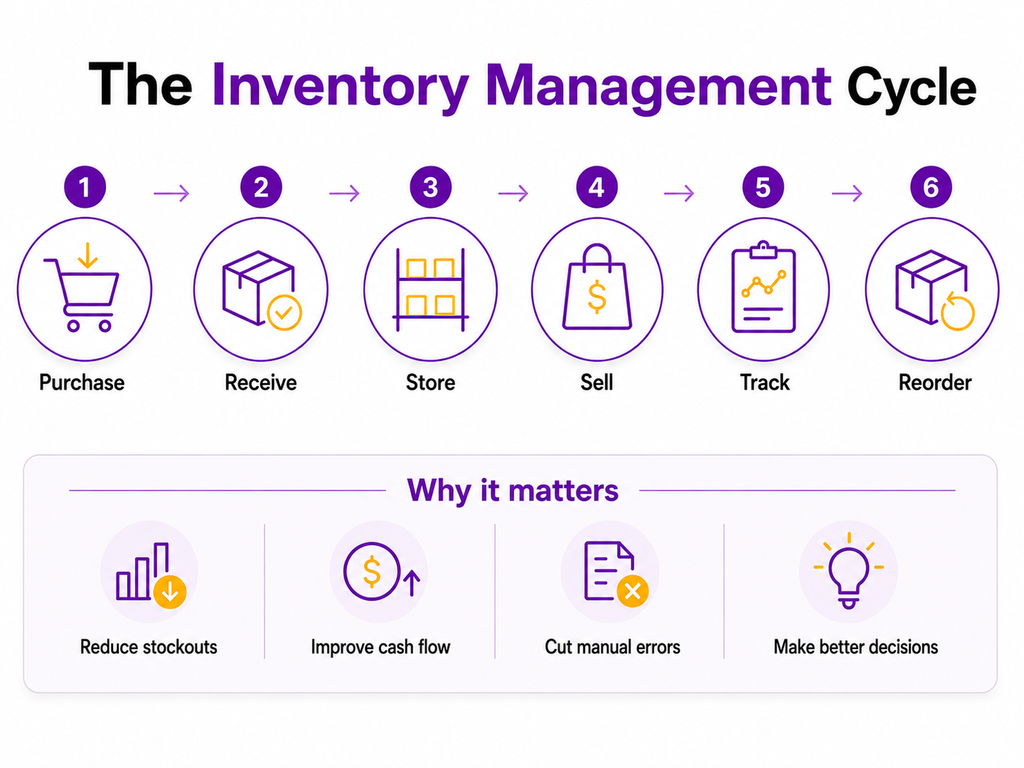
Inventory moves through several stages, from purchasing products to selling them to customers.
The process begins with purchasing. Businesses need to decide what products they need, how much they should order, and when they should place supplier orders. Good purchasing decisions should consider sales patterns, current stock levels, and supplier delivery times.
When products arrive, businesses need to confirm that the correct items and quantities have been received. Errors at this stage can create inaccurate records that affect future decisions.
After receiving stock, products need to be stored and organised properly. Businesses should have a clear understanding of where products are located and how they can be accessed efficiently.
When sales take place, inventory records should update to reflect the movement of products. This allows businesses to understand their current stock position and identify when action is required.
The final stage is monitoring and replenishment. Businesses need to review stock levels regularly and reorder products before they create supply problems.
Common Inventory Challenges Small Businesses Face
As businesses grow, inventory management often becomes more complex.
One common challenge is inaccurate stock records. A business may believe it has a certain quantity available, but the physical stock tells a different story. These differences can happen because of unrecorded sales, incorrect deliveries, damaged products, or manual errors.
Another challenge is stockouts. When a business runs out of popular products, it can result in lost revenue and customers choosing alternative suppliers.
Overstocking creates a different problem. Products that remain unsold for long periods represent money that is not actively supporting business growth.
Businesses also face challenges when managing multiple locations. Without clear visibility, one location may have excess stock while another appears to need more products.
These challenges are not always caused by poor decisions. Often, they happen because businesses do not have accurate information available when decisions need to be made.
How to Improve Inventory Control
Strong inventory control starts with reliable processes.
The first step is maintaining accurate product records. Every product should have clear information, including its name, category, quantity, pricing details, and supplier information.
Businesses should also track every stock movement. Products entering the business, products being sold, transfers between locations, returns, and adjustments should all be recorded.
Regular stock reviews are equally important. Physical stock checks help identify differences between records and actual inventory. Some businesses conduct complete stock counts, while others use cycle counting to review selected products regularly.
Businesses should also review inventory performance. Understanding which products sell quickly, which products move slowly, and which products create the most value helps improve purchasing decisions.
Inventory Management and Cash Flow
Inventory and cash flow are closely connected.
A business can appear successful while still experiencing financial pressure because too much money is tied up in stock.
For example, a retailer may purchase a large quantity of products in anticipation of strong demand. If those products sell slowly, the business may have valuable inventory but limited available cash.
Better inventory visibility helps businesses understand:
- Which products generate sales
- Which products are moving slowly
- Where money is tied up
- When additional purchases are needed
This information allows businesses to make more informed decisions instead of purchasing based on assumptions.
Inventory management is therefore not only an operational function. It is also an important part of financial control.
Manual Inventory Tracking vs Inventory Management Software
Many small businesses begin with spreadsheets because they are simple and affordable.
However, as the business grows, manual tracking can become difficult to maintain. More products, more transactions, and more employees increase the possibility of errors.
Common problems with manual inventory processes include outdated information, duplicated records, inconsistent updates, and limited visibility.
An inventory management system helps businesses centralise their stock information.
A good system can provide real-time stock visibility, stock movement tracking, purchasing information, reporting, and better coordination between sales and inventory activity.
Instead of spending time searching through different records, businesses can access clearer information when they need it.
Features to Look For in an Inventory Management System
The right inventory management system should support the way a business operates.
Important capabilities include:
Real-Time Stock Visibility
Businesses should be able to quickly understand current stock levels without relying on separate spreadsheets or manual checks.
Low-Stock Alerts
Low-stock alerts help teams identify products that require attention before they affect customers.
Stock Movement Tracking
Businesses should know when products enter, leave, or move between locations.
Reporting and Insights
Inventory reports help businesses understand product performance, stock value, purchasing patterns, and operational trends.
Multi-Location Management
Businesses operating across multiple branches or warehouses need visibility across different locations.
Sales Integration
Connecting sales activity with inventory records helps maintain more accurate stock information.
How Abbpay Inventory Helps Growing Businesses
As businesses expand, managing stock through disconnected tools becomes increasingly challenging.
Abbpay Inventory helps businesses improve stock visibility by consolidating inventory activity into a single connected platform.
Businesses can monitor stock levels, manage products, track stock movements, and gain clearer insight into inventory activity.
By connecting inventory information to everyday business operations, Abbpay helps businesses reduce uncertainty and make better-informed decisions.
Instead of asking, “How much stock do we think we have?”, businesses can work from a clearer understanding of what is available, what needs attention, and where improvements can be made.
Frequently Asked Questions
What is inventory management for small businesses?
Inventory management for small businesses is the process of tracking, organising, and controlling products to maintain accurate stock levels, reduce waste, and support better purchasing decisions.
Why is inventory control important?
Inventory control helps businesses maintain accurate stock records, prevent shortages, reduce unnecessary purchases, and improve operational efficiency.
Do small businesses need an inventory management system?
Small businesses may benefit from an inventory management system when manual tracking becomes difficult, product ranges increase, sales volume grows, or multiple people need access to accurate stock information.
How can businesses improve inventory accuracy?
Businesses can improve inventory accuracy by maintaining reliable records, tracking stock movements, performing regular stock checks, and using connected systems.
Better inventory decisions start with better visibility.
Inventory management is not simply about knowing how many products are on a shelf. It is about understanding how stock moves through the business, where money is tied up, and how better information can improve everyday decisions.
For growing businesses, creating reliable inventory processes means fewer surprises, better purchasing decisions, and stronger operational control.
With the right systems in place, businesses can move from reacting to stock problems to proactively managing their inventory.