

Business silos rarely appear overnight. They build quietly as a company grows. A team creates a spreadsheet to solve a problem. Another department adopts a different tool because it works better for their needs. Important information starts living in different places, and before long, the business has several versions of the same information.
A sales team tracks customer details in one system. Finance manages payments somewhere else. HR stores employee information separately. Operations rely on another platform to manage daily activities.
Each system may work well on its own, but the business as a whole becomes harder to manage.
For growing businesses, disconnected systems create more than inconvenience. They increase manual work, slow down decisions, create errors, and make it harder for teams to understand what is really happening.
Breaking down business silos is about creating better connections between people, processes, and information.
What Are Business Silos?
Business silos happen when teams, departments, or systems operate separately without enough information sharing or connection.
A silo can exist when one department has information that another department cannot easily access, when teams use different systems that do not communicate, or when employees follow different processes for similar tasks.
Silos are not always created by poor management. In many cases, they develop as the business grows.
A small business may start with simple processes because everyone works closely together. The owner understands the numbers, employees communicate directly, and information is easy to find.
As the company grows, more people become involved. Teams specialise. More software tools are introduced. Processes become more complex. The systems that worked during the early stages may no longer support the business effectively.
Why Do Business Silos Form?
Most silos start with good intentions. A finance team chooses a tool to manage reporting. HR creates a separate process to keep employee information organised. Operations introduces software to improve efficiency.
Each decision solves a specific business problem. The challenge begins when these systems operate independently and important information stops flowing between teams.
Instead of spending time making decisions, employees spend time moving information between systems, checking records, and confirming which version is correct.
For example, a simple employee update may require several steps:
- HR updates employee details.
- Payroll needs the updated information.
- Finance needs to understand the cost impact.
- Management needs visibility for workforce planning.
Without connected systems, each team may be working from a different version of the same information. Over time, this creates confusion, increases manual work, and slows decision-making.
The Different Types of Business Silos
Understanding where silos exist is the first step towards solving them.
System Silos
System silos happen when important information is stored across different platforms that do not connect.
For example, employee records may live in an HR system, payroll information may sit elsewhere, and financial data may be managed separately.
When systems do not share information, employees often have to transfer data between platforms manually. This increases the chance of mistakes and creates unnecessary administrative work.
Process Silos
Process silos happen when different teams handle similar activities in different ways.
One manager may approve leave through email. Another may use a shared document. Another may rely on a messaging platform.
Each method may work individually, but the business loses consistency and visibility.
Clear processes help teams understand how work moves through the organisation and who is responsible at each stage.
Information Silos
Information silos occur when important knowledge exists with individuals rather than being available across the business.
This creates risk because the organisation becomes dependent on specific people.
If someone changes roles, leaves the company, or becomes unavailable, important knowledge can disappear.
Department Silos
Department silos happen when teams focus only on their own responsibilities without understanding how their work affects other parts of the business.
Finance may focus on budgets and costs. HR may focus on employee needs. Operations may focus on delivering products or services. Each perspective matters, but better decisions happen when teams can work from shared information.
The Hidden Cost of Disconnected Business Systems
Silos can feel harmless because their impact is usually spread across many small tasks.
A few minutes spent copying information. An extra email requesting an update. A spreadsheet checked against another spreadsheet. A report delayed because nobody knows which figures are correct.
Over time, these small problems become expensive. Disconnected systems create unnecessary manual work. Employees spend time entering, checking, and correcting information instead of focusing on activities that support customers and business growth.
They also increase the risk of errors. Every time information is transferred manually, there is a possibility that something changes or becomes outdated.
A payroll update may not reach the right person. A financial report may not reflect the latest information. An inventory figure may not match what is actually available.
Silos also slow down decision-making. Business leaders need accurate information to make effective decisions. When data is scattered across different systems, teams spend more time gathering information and less time acting on it. A connected business has greater visibility because people can access the information they need when they need it.
Why HR, Finance, and Operations Need Connected Information
Some of the biggest effects of silos happen between HR, Finance, and Operations because these teams manage different parts of the same business reality.
HR understands the people side of the organisation. Finance understands the financial impact. Operations understands how work is delivered daily.
All three areas need accurate information to make better decisions.
For example, when a new employee joins a business, several teams are involved.
HR needs to record employee details and manage onboarding. Payroll needs accurate information to process payments. Finance needs to understand the impact on costs and budgets. Managers need visibility of workforce changes.
When these systems are disconnected, employees waste time ensuring everyone has the same information. Connected systems reduce this gap by allowing important information to flow between the areas that need it.
Improving Communication and Collaboration Across Silos
Business silos aren’t created only by disconnected systems. They can also develop when teams lack enough context about how their work connects with others.
Different departments often view the business from their own perspective. Finance focuses on costs and reporting. HR focuses on people and employee processes. Operations focuses on delivering products and services. Each perspective is valuable, but problems arise when teams cannot easily connect their information, priorities, and decisions.
A shared understanding helps teams work towards the same goals.
Clear communication, consistent processes, and accessible information create a common language across the business. When employees understand how their work affects other teams, collaboration becomes easier, and decisions become faster.
For example, a change to an employee’s role should not only exist within HR records. It may affect payroll, budgets, reporting, and operational planning. When the right teams have access to the right information, fewer updates are missed and less time is spent clarifying details.
Building this starts with a culture that values both ownership and collaboration. Strong cross-functional collaboration helps teams understand shared goals, improve communication, and work from a clearer understanding of how their decisions affect other parts of the business. Connected systems then provide the structure that helps teams stay aligned as the business grows.
How to Break Down Business Silos
Breaking down business silos does not require replacing every system immediately. It starts with improving how information moves through the business and making it easier for teams to work together.
The goal is not simply to introduce more technology. It is to create clearer processes where people can access accurate information and understand their responsibilities.
Create a Single Source of Truth
Businesses need a reliable place where important information is stored and maintained.
This does not mean every piece of information must exist in one location. It means teams should know where accurate information comes from and trust the data they are using.
For example, employee information should not require HR, payroll, and finance teams to compare separate spreadsheets before making a decision. A connected system allows everyone to work from consistent information.
A single source of truth reduces confusion, prevents duplicate records, and improves confidence in business decisions.
Connect Your Business Systems
Disconnected tools create disconnected information. When systems do not communicate, employees spend time moving data manually between platforms. This creates unnecessary work and increases the chance of errors.
Connected business systems allow important information to flow between different areas of the organisation.
For example, employee information can support payroll processes, financial reporting can reflect operational activity, and inventory information can provide better visibility into sales and purchasing decisions.
The aim is not to have the most software tools. It is to have systems that work together.
Standardise How Information Is Recorded
Even connected systems can become difficult to manage if teams record information differently.
One employee may use a full customer name while another uses an abbreviation. One team may update records immediately while another waits until the end of the week.
Small differences create larger problems as the business grows.
Creating consistent processes for recording, updating, and managing information helps teams work more efficiently and reduces unnecessary corrections.
Define Ownership Clearly
Many information gaps happen because nobody is completely responsible for maintaining a process.
Teams may assume another department has updated a record or completed a task, which creates delays and confusion.
Clear ownership helps prevent this. Every important process should have someone responsible for ensuring information is accurate, tasks are completed, and updates reach the right people.
Review Systems and Processes Regularly
Silos do not disappear permanently.
As businesses grow, new employees join, new tools are introduced, and processes change. Without regular reviews, disconnected systems and inefficient workflows can slowly return.
Businesses should regularly ask:
Are employees entering the same information in multiple places?
Are teams using different methods for the same process?
Are decisions delayed because information is difficult to access?
Regular reviews help identify problems before they become major operational challenges.
Signs Your Business Systems Are Becoming Disconnected
Many businesses do not notice silos until they begin affecting daily operations.
Some common signs include employees entering the same information into multiple systems, teams regularly asking each other for updates that should already be available, and reports from different departments showing different figures.
Other warning signs include important processes depending on one person’s knowledge, managers spending too much time searching for information, and employees spending more time correcting errors than improving processes.
These challenges usually indicate that the business has grown beyond the systems and processes that supported it in the earlier stages.
Recognising these signs early allows businesses to improve their systems before the problems become more expensive.
How Technology Helps Reduce Business Silos
Technology does not automatically solve business silos.
A business can still have disconnected processes even when it uses several modern software tools. The difference comes from choosing systems that support the way the business operates.
Connected platforms help businesses organise information, reduce repeated data entry, improve visibility, and allow teams to work from more consistent information.
The value is not only saving time. It is creating confidence that decisions are based on accurate and up-to-date information.
For growing businesses, connected technology creates a stronger foundation for scaling. As more employees, customers, transactions, and locations are added, having reliable systems becomes increasingly important.
Abbpay Helps Businesses Connect Their Operations
As businesses grow, managing HR, payroll, accounting, inventory, and client information across separate systems can create unnecessary complexity.
Abbpay helps businesses bring these important operational areas together through one connected platform.
Instead of managing different tools that operate separately, businesses can create better visibility across areas such as:
- Employee records and HR processes
- Payroll management and workforce costs
- Accounting and financial reporting
- Inventory tracking and stock visibility
- Accountant access for managing multiple client businesses
The benefit is not simply having multiple features in one platform.
The real value is reducing the gaps between different parts of the business.
When HR, Finance, Operations, and leadership teams work from connected information, they can spend less time searching for answers and more time focusing on decisions, customers, and growth.
Connected systems also help businesses create more consistent processes. Information entered in one area can support activities across the organisation, reducing unnecessary manual work and improving operational visibility.
Building a More Connected Business
Business growth naturally creates complexity. More employees, more customers, more transactions, and more processes all create new information challenges. The systems that supported a small business may not always support the next stage of growth.
Breaking down business silos is not about collecting more tools. It is about creating better connections between people, processes, and information.
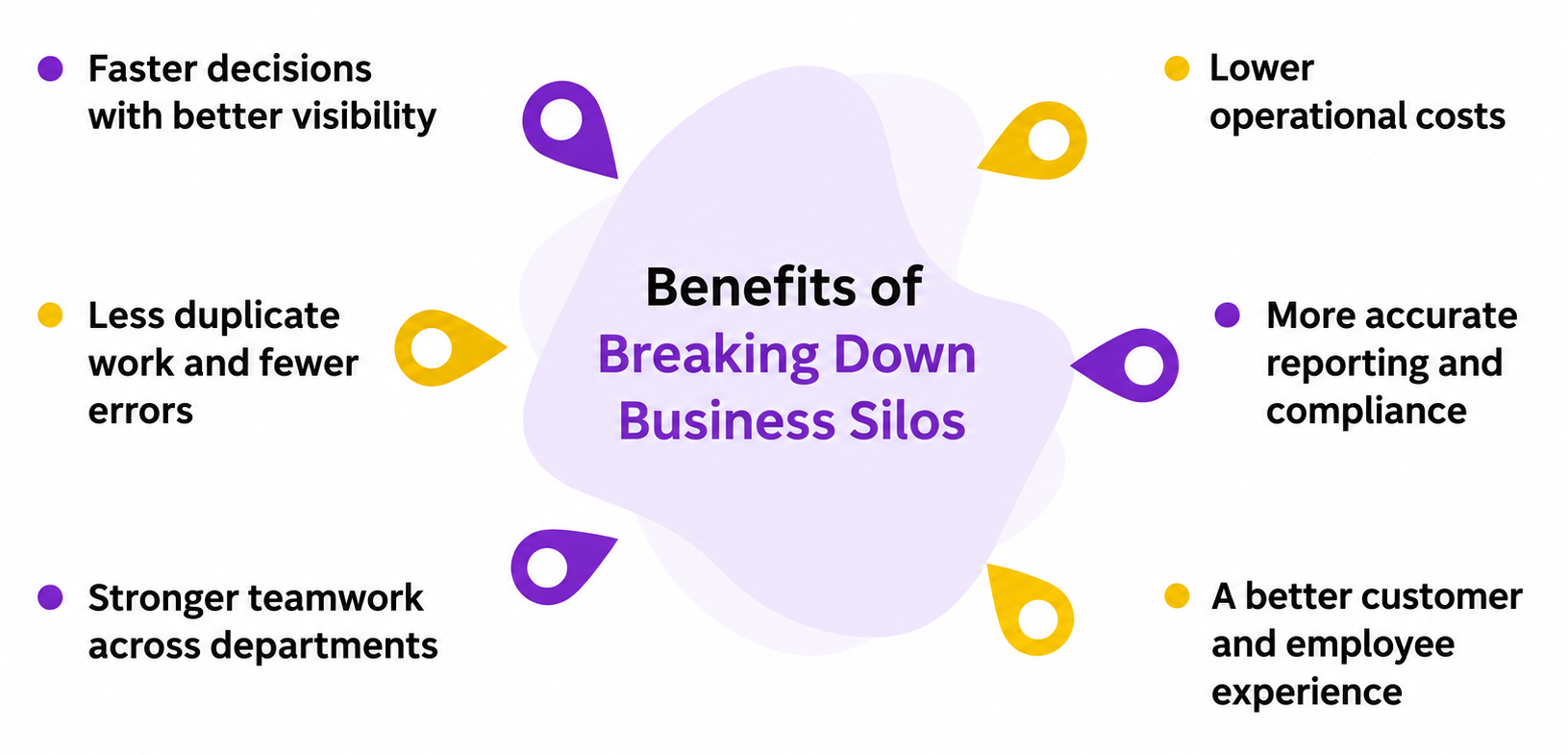
Businesses that improve how their systems communicate can reduce manual work, make better decisions, and give their teams the visibility they need to perform effectively.
The most successful businesses are not always the ones with the most software. They are the ones where their systems help people access the right information at the right time.
Building a connected business creates the foundation for better collaboration, stronger operations, and sustainable growth.
Want to see how Abbpay can connect your business? Learn more by requesting a demo.